
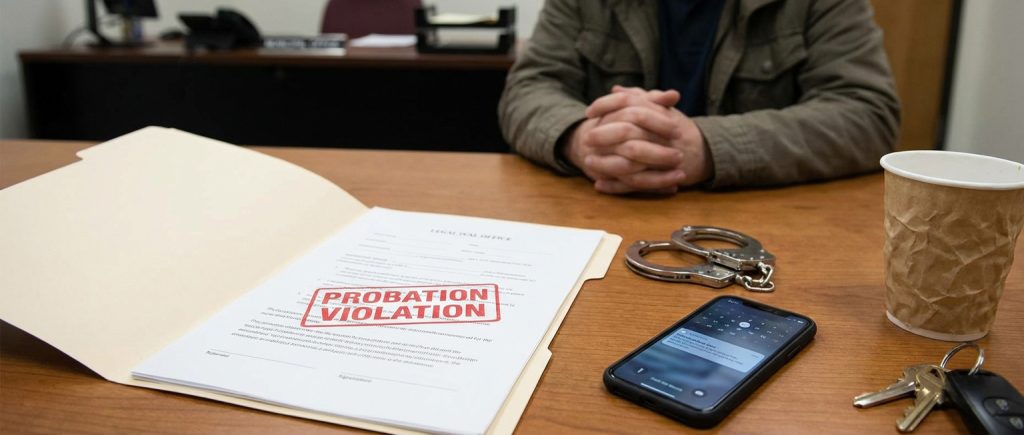
Probation Violations in New Jersey
What Happens If You Violate Probation – and How Mark Bailey Can Help
In New Jersey, probation is often given as an alternative to jail or state prison. It’s a second chance—but it comes with strict conditions. If the court believes you violated those conditions, you can be brought back to court on a violation of probation (VOP) and face serious consequences, including jail or prison time.
Probation terms and violations are governed by New Jersey law, including N.J.S.A. 2C:45-1 through 2C:45-3, as well as court rules and county probation policies. In general, a violation can be based on:
-
A new arrest or conviction
-
Repeated positive drug tests
-
Missing reporting appointments with your probation officer
-
Failing to complete counseling, treatment, or community service
-
Not paying fines, fees, or restitution when able
-
Ignoring no-contact orders or other specific conditions
If you’ve been notified of a probation violation or have a VOP warrant, you’re at risk of losing your original “break” and being sentenced all over again—this time with fewer chances for leniency.
How Attorney Mark Bailey Approaches Probation Violation Cases
Attorney Mark Bailey understands that not every violation means someone is out committing new crimes. Often, probation issues come from:
-
Addiction or mental health struggles
-
Transportation, job, or childcare problems
-
Miscommunication with a probation officer
-
An honest mistake that snowballed into a warrant
He takes a selective, hands-on approach, limiting the number of probation cases he handles so he can:
-
Review the original sentence and conditions of your probation
-
Analyze exactly what the violation is based on (new offense vs. technical violation)
-
Obtain and review probation reports, drug test results, and police records
-
Help you address underlying problems (treatment, employment, documentation) before the hearing
-
Present a strong argument for keeping you on probation or minimizing any penalties
The goal is to keep you out of jail if possible, protect your record, and convince the judge that you deserve another chance—or at least a lesser sanction.
What Is a Probation Violation in New Jersey?
When you are sentenced to probation, the court gives you a list of conditions. These may include:
-
Reporting regularly to a probation officer
-
Obeying all laws (no new arrests or convictions)
-
Remaining drug and alcohol free and submitting to testing
-
Completing counseling, anger management, substance abuse treatment, or other programs
-
Performing community service
-
Paying fines, fees, and restitution
-
Having no contact with certain people or places
If the probation officer believes you failed to follow these terms, they can file a violation of probation with the court. A judge may:
-
Issue a summons ordering you to appear, or
-
Issue a warrant and have you arrested and brought before the court
Probation violations fall into two broad categories:
-
New offense violations – You’re accused of committing a new crime or disorderly persons offense while on probation.
-
Technical violations – You’re accused of breaking a condition (missed appointments, dirty urine, non-payment, etc.) even if no new crime occurred.
Both types are serious, but the strategy and possible outcomes can be very different.
The Probation Violation Process
If you’re facing a probation violation in New Jersey, you can generally expect:
-
Notice of Violation / Warrant
-
Probation files a violation report; you may receive notice, or be picked up on a warrant.
-
-
First Appearance / Detention Decision
-
You appear before a judge who reviews the allegations, advises you of your rights, and decides whether to release you, continue you on probation pending hearing, or detain you until the VOP hearing.
-
-
Violation of Probation Hearing
-
This is not a full-blown jury trial. It’s a hearing before a judge where the State must prove that you violated probation.
-
The standard of proof is lower than “beyond a reasonable doubt” in most cases—often “preponderance of the evidence” or a similar standard, depending on the issue.
-
You have the right to an attorney, to present evidence, and to challenge the State’s proof.
-
-
Disposition / Resentencing
-
If the judge finds a violation, they can:
-
Continue probation unchanged
-
Continue probation but modify conditions (stricter terms, extra reporting, treatment, community service)
-
Extend the length of probation
-
Revoke probation and resentence you—possibly to county jail or New Jersey State Prison up to the maximum of the original charge
-
-
Because the judge can go back and impose any sentence that was available at the original sentencing, a violation can turn a no-jail or short-jail case into a serious incarceration risk.
Possible Consequences of a Probation Violation
The consequences depend on:
-
The original charge and degree (disorderly persons vs. fourth, third, or second-degree crime)
-
Your prior record and prior violations (if any)
-
The nature of the violation (new felony vs. missed appointment vs. failed drug test)
-
What you’ve done right on probation (employment, family responsibilities, treatment progress)
Potential outcomes include:
-
Warning or continued probation under the same terms
-
Stricter conditions (curfew, more frequent reporting, additional treatment)
-
Extension of probation term
-
Short county jail term as a condition of continued probation
-
Full revocation of probation and imposition of the original custodial sentence (which, for indictable offenses, can mean years in prison)
Having a lawyer like Mark Bailey can make the difference between going home and going into custody.
Common Defenses & Strategies in Probation Violation Cases
Every VOP case is different, but frequently raised themes include:
-
It didn’t happen as alleged – Challenging the factual basis of the violation (e.g., you did report, you did pay, or there’s an error in the probation records).
-
No willful violation – Showing that any failure was not intentional (e.g., medical emergency, lack of transportation, job conflict, inability—not refusal—to pay).
-
New charge not yet proven – Arguing that the court should not revoke probation based on an arrest alone, especially while the new case is still pending or weak.
-
Substantial compliance – Emphasizing all the things you have successfully done on probation to argue for leniency.
-
Alternative plan – Presenting a concrete plan to address the problem (e.g., enrolling in treatment, changing jobs, moving residences, getting counseling) instead of going to jail.
Mark Bailey will:
-
Go over the violation notice line by line
-
Collect documents, proof of payments, medical records, work schedules, and other evidence that supports your side
-
Work with treatment providers or counselors to show the court you are actively addressing the issues
-
Argue strongly for a resolution that keeps you in the community whenever possible
Probation vs. Parole – Don’t Confuse the Two
People often confuse probation and parole, but they are different:
-
Probation is a sentence imposed by the court instead of (or in addition to) jail or prison.
-
Parole is early release from prison under supervision by the New Jersey State Parole Board.
Parole violations follow different rules and are handled in a different process, but both can result in you being taken back into custody. If you’re not sure which one applies, Mark Bailey can help you figure it out and guide you through the correct process.
Why You Shouldn’t Just Admit to a VOP Without Counsel
Many people think, “They’ve already decided I violated—there’s no point fighting it.” That’s not true.
Even if some violation did occur, a lawyer can often:
-
Limit what the court finds you violated
-
Help you avoid full revocation and a long jail/prison term
-
Negotiate for treatment-based or community-based solutions
-
Protect you from accidentally admitting to facts that hurt you in a new, separate case
Before you admit anything in court, you should speak to an attorney who understands how much is really at stake.
The Law Office of Mark A. Bailey is dedicated to defending clients at every stage of the criminal process—including probation violation hearings—and fighting to keep them in the community whenever possible.
Contact Mark Bailey today for a confidential consultation to discuss your probation violation, your options, and the best strategy for moving forward.
 1309 Bound Brook Road